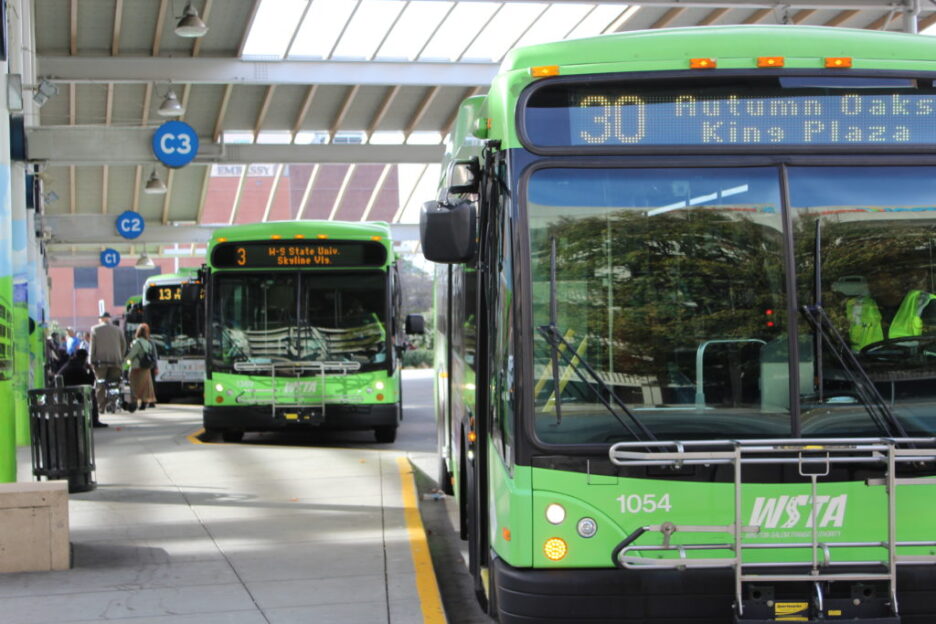
It’s a sunny Tuesday afternoon in Downtown Winston-Salem, and no spot is busier than the Clark Campbell Transit Center. Despite the COVID-19 pandemic, the Transit Center has remained ripe with activity, even as Downtown’s retail and entertainment landscape have seemed barren.
Located at 5th and Trade Streets, the Transit Center is the backbone of the Winston-Salem Transit Authority (WSTA). Twenty three of WSTA’s 30 routes serve the Transit Center, and essential workers have been connecting here on their commutes to work throughout the entirety of the pandemic.
In order to operate throughout the pandemic, various safety precautions were put in place to protect the community. According to Tina Carson-Wilkins, a customer service representative, masks are mandated on WSTA buses, and riders are provided a mask if they do not have one. WSTA has purchased 200,000 masks since the onset of the pandemic, and has received a further 20,000 through donations, said Carson-Wilkins. Buses are also cleaned extensively overnight, with the transit authority having received a 12.4 million dollar grant through the Federal Cares Act to pay for masks and cleaning services.
One rider, Lewis Cannon Jr., says he’s satisfied with the safety precautions WSTA has put in place, but that hasn’t stopped him from taking his own safety measures.
“I just try to wipe everything down twice, because I really don’t want to bring the virus home with me,” said Cannon.
Along with mask mandates and nightly cleanings, other restrictions were put into effect to protect riders and operators. From the onset of the pandemic up until January 4th, 2021, buses were capped at 15 passengers and ran on “Level 1” service, which means that routes switched to Saturday schedules. To compensate for less frequent service, passenger restrictions and route changes, WSTA operated fare-free until Jan. 4. Despite the free fares, WSTA ridership dropped 17% from the onset of the pandemic to Jan. 4, said Carson-Wilkins.
On Jan. 4, a sense of normalcy began to creep back into the WSTA system. Buses were allowed to increase capacity to 25 passengers, service was switched off of “Level one” back to normal weekday service, and fares were re-introduced to recoup lost revenue. Despite looser restrictions, WSTA is still waiting for passenger numbers to recover to pre-pandemic levels. In fact, since free fares were scrapped on Jan. 4, ridership has sinced dropped by 47%, according to Carson-Wilkins.
Free fares had quite the impact on the community. Sergeant Kevin Bowers of the Downtown Bike Patrol said that he noticed an uptick of teens gathering at the Transit Center, one of which caught his attention in particular.
“We had an instance where we located an individual who was involved in a car theft on the north end of town… We chased him up the street from 5th and Trade towards Mast General Store, where we were able to take him into custody,” said Bowers.
Bowers also mentioned another incident where a group of teens was able to use WSTA buses to flee from an assault at Hanes Mall.
“Upon hearing sirens, the juveniles were told to jump on the bus. They didn’t have to worry about paying to get on a bus and they were able to use the bus to get away,” Bowers said.
While waiting for his bus to go to work on this sunny afternoon, WSTA rider Andrew Carter had a brighter assessment of the free fares, and acknowledged that WSTA’s overall handling of the pandemic made commuting to work during the pandemic as smooth as possible.
“I never really had any problems commuting to work during this pandemic, and the free fares were a great thing they did to help people out in a time of need,” Carter said.
Reporting Index
Tina Carson-Wilkins, WSTA customer service representative; t-carson-wilkins@wstransit.com
Kevin Bowers, WSPD patrol officer; kbowers@wspd.org
Lewis Cannon Jr., WSTA passenger
Andrew Carter, WSTA passenger
External Sources
“WSTA Home.” Winston-Salem Transit Authority, 17 Mar. 2021, wstransit.com/.
