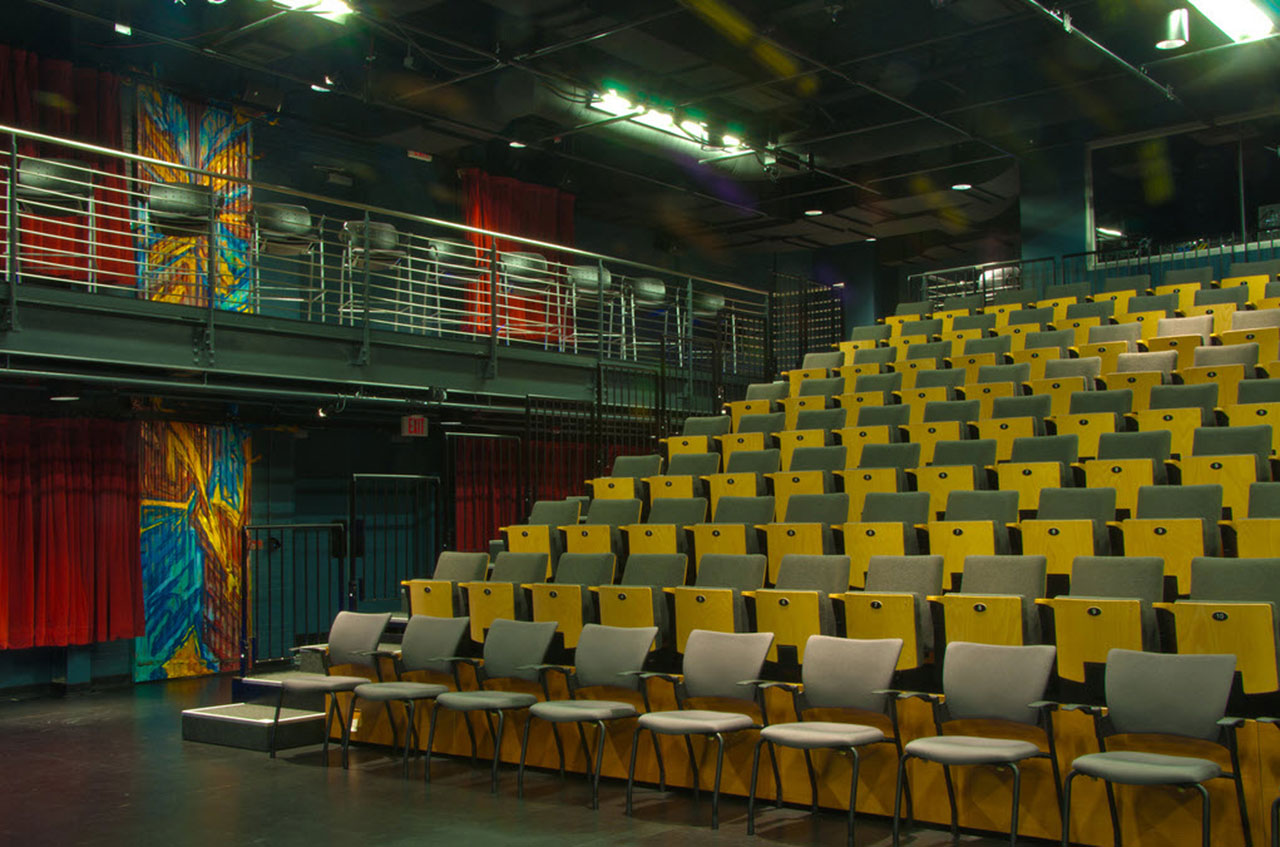
Last weekend the University of North Carolina School of the Arts 2021 season opened at the Stevens Center with a production of The Winter Opera. The lights came up on singers dressed in 18th-century costumes on an intricately designed set in an otherwise empty theater. The audience watched the performance at home over UNCSA On Demand.
Even though seats are empty, the Stevens Center stage is not. Many in Winston-Salem will recall The Nutcracker released for free to the public in video format this past December. In February of this year, the Winston-Salem Symphony streamed and recorded their “Valentines Mixtape” concert, one of many future projects according to the Winston-Salem Journal.
With the pandemic still looming, keeping the performers and technicians safe during these performances is a major concern of Wiley Hausam, the Managing Director of Performance Facilities at UNCSA.
“It is a constantly moving target,” says Hausam. “We have protocols for all of our performances no matter who is in the space. Ideally we want to keep everyone six feet distance and everyone must wear a mask even if they have been vaccinated.”
The UNCSA protocols for their spaces are rigorous, especially for the students. Each and every student working in the Stevens Center, or anywhere else for that matter, must fill out a coronavirus survey to see if they have been experiencing any symptoms of recent. Then they are temperature checked upon entering the space and remain masked and socially distanced throughout the rehearsal. Another caveat; absolutely no mingling.
“We can’t take risks because our singers are unmasked for the streaming service,” says Omar Sosa, the production assistant for this year’s UNCSA Winter Opera. “So, every single part of the production has a specific time slot to work on whatever thing they have before our performers come onto the stage where absolutely nobody is allowed in the space.”
UNCSA also teamed up with The Arts Council of Winston-Salem and Forsyth County back in October and November of 2020. UNCSA rented two spaces downtown including the Hanesbrands Theater and the Reynolds Place Theater for three performances.
“Down in the Face of God” was released on Mar. 8 and “Sweat” will be released on Mar. 12. Both of the shows will be in a streaming format. The third performance, “An Afternoon at the Opera” will be live streamed at the Hanesbrands on Mar. 28.
“We do not expect to see any audience in any space until December of 2021,” says Hausam. “Keeping our students and the Winston-Salem community safe is and will continue to be our number one priority.”
As of Feb. 23, Governor Roy Cooper eased restrictions allowing for venues to operate at a 30 percent capacity limit that may not exceed 250-person in indoor spaces. Hanesbrands Theater operates through rental space. If there are no shows to put on, it is very difficult for venues like Hanesbrands and Reynolda Place to continue running without community support.
“Based on social distancing and everything, our number went from 25 audience members to 50 or 60 audience members,” says John Horsman, the theater manager for the Arts Council.
For local theater, that is no small win. Many of the smaller companies in Winston-Salem rely on ticket sales to fund their performances. If thesales are too low, theater troupes are better off not pulling a show together at all.
“We are operating at around 10 percent of what we would have earned by now at this point of the year,” says Horsman.
Since the beginning of the pandemic, there have been countless cancellations by theaters that typically use the space. For instance, the RiverRun International Film Festival has had to cancel two years in a row. The Little Theater of Winston-Salem cancelled all four of their productions last year as well as this year. The Winston-Salem Festival Ballet canceled their production of Dracula last year.
The Hanesbrands has managed to find space for other events to fill the gaps. Small socially distanced summer camps run in the space by Spring Theater helped make up for lost revenu through the summer months and a blood drive this past February.
From Mar. 3 – 11 the building is hosting the Spring Arts Extravaganza where students K-12 will be able to display their works including painting, drawing, sculpture, photography, and mixed media.
Because of the pandemic, the theater has had to reimagine what these kinds of recurring events look like under different circumstances.
“If the pandemic has taught us anything it’s how to problem solve,” says Horsman. “The issue of crowd control with this particular event is now being handled with a time-slot set up that keeps crowds down while allowing people to better enjoy the art.”
