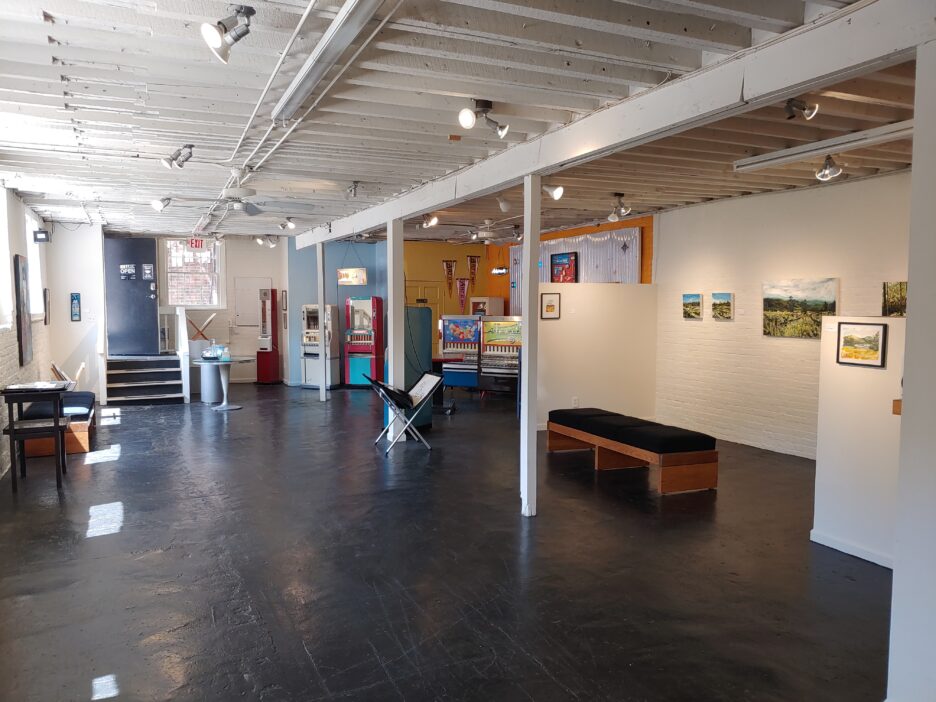
Passing through the threshold of the Delurk Gallery means descending into the Winston-Salem art scene. Like, physically descending the wooden steps into an open white brick room filled with hanging art above an uneven stone floor. Various Art-O-Mat machines stand to the side of the room. Instead of dispensing cigarettes, they dispense art.
“It literally embodies the word ‘underground,’’’ said Delurk patron and Wake Forest sophomore Roxie Ray.
Delurk Gallery sits on (below) 6th St, in the heart of the downtown Arts District. The Delurk Gallery opened in 2012 and showcases local area artists to help develop a sense of community, according to gallery co-founder Jennifer O’Kelly.
“We will show quality artwork by people who are serious about what they are doing, by people at all stages of their careers,” said O’Kelly.
Delurk gallery is made up of two rooms, the main gallery and the smaller showroom attached at the back of the space. Most of the floor space is left free for gallery browsing, with benches near the featured artist wall to give viewers a place to rest. The gallery changes the art monthly, so depending on when you go in, you might see examples of a variety of styles and mediums. Oil landscape paintings on wood blocks sit across from abstract art and works created from felt. The collective wall is home to the majority of the art in the space, carefully curated to make sure the different styles play off each other in an interesting way, according to O’Kelly.
The gallery is home to a group of artists who are considered members, meaning that they must submit new works six times per year to meet their obligation to the gallery. Members are under contract with Delurk Gallery to make sure art is constantly being produced for the next gallery rotation. At any given time, you can find six to twelve artists on the webpage, according to O’Kelly.
“A full-time artist is committing 20 hours a month of actual material participation in the gallery operation, which is how we cover sitting the gallery, curation, finding new artists, and event coordinating,” said O’Kelly. Participation at Delurk Gallery means taking a role in the running of the gallery, as well as producing artwork.
The focus of the gallery is fostering a conversation between the community and the artist, while also acting as a way for artists to become involved in all aspects of the gallery. The website states the definition of Delurk as, “To participate in something you only previously spectated.”
“It’s unlike any other collaborative thing I’ve ever done,” said O’Kelly. “This is a long-term relationship with other artists to serve the public.”
Like many local businesses, the gallery has struggled with navigating the COVID-19 pandemic. The gallery was forced to close down last March, reopened with reserved viewing times in June, and reopened to foot traffic this February. To spark community engagement, the gallery started to host guest artists.
“When we reopened in February, each one of us went out and contacted the people who have studios near our studios to see who was working, who was in the neighborhood,” said O’Kelly. “Like, physically within two blocks of the gallery. Hyperlocal.”
An art gallery needs people in the space to look at the art, which becomes difficult when trying to keep the community safe. The gallery attempted to set up an online store, but found trouble shipping the art safely. Special precautions need to be taken to preserve the art while in transport to ensure that the art remains undamaged.
“People bought pieces online, and they were in California,” said O’Kelly. “But we didn’t have a mechanism to figure out shipping.”
Before the pandemic, Delurk Gallery hosted both musical events and rented the space out for a variety of events, such as anniversary parties and graduation dinners. Since the start of the pandemic, the gallery has not been able to rent out or host in the space.
“For the three years immediately prior to the coronavirus, we paid half of our annual rent through event rentals,” said O’Kelly.
When walking the gallery, you can talk with the creators of the works or those who know them personally, and gain background insight into their art.
“We believe that by making it accessible and honest, and presenting the art in a way that you can see it on its own terms, but also so that you can find out more about it, that we will sell art, enough art,” said O’Kelly. “Maybe not as much, but enough art to keep showing more art.”
