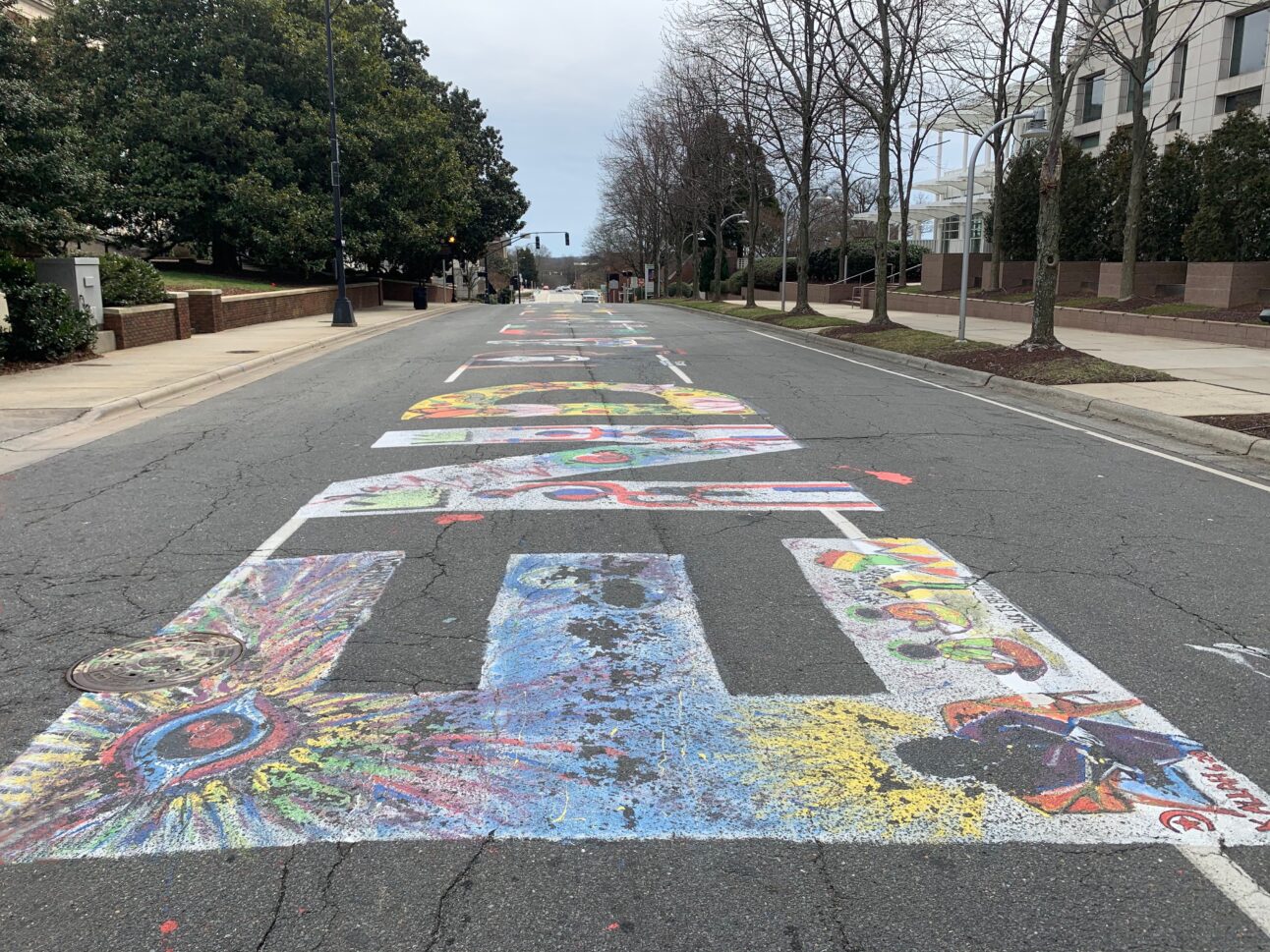
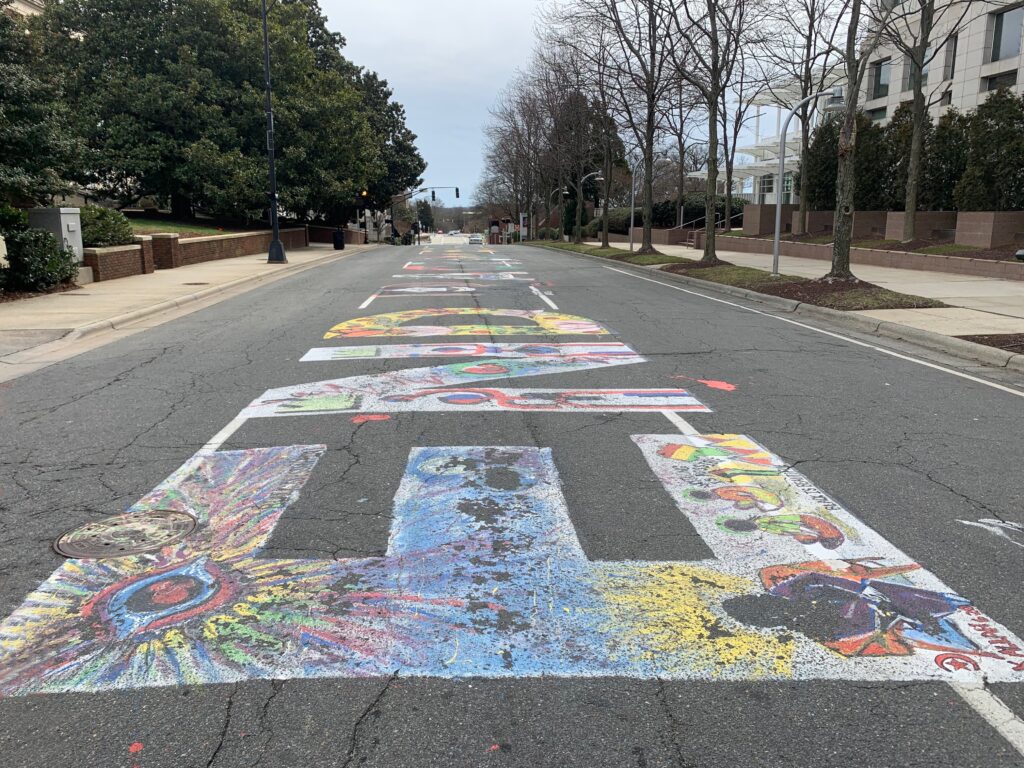
Painted on the asphalt the length of a full block on Main Street, an expansive mural outside of City Hall declares in bold lettering: “End Racism Now #BLM.”
Although some of the vibrant colors have faded, the symbolism of this mural’s placement outside City Hall’s main entrance still remains. Anyone who enters Winston Salem’s central government building passes this powerful call to action.
“It makes the people at City Hall think about the policies that need to change,” April Reich, one of the 18 local artists who contributed to this massive project, said. “We want to make the universe a better place and that change has to start here.”
Artists from across Winston Salem came together to paint this massive street mural on June 13, 2020, inspired by a national outcry of Black Lives Matter activism. This project was organized by the Winston Salem Community Mural Project, a grassroots social activism project led by community leader and CEO of Honorable Youth, Rasheeda Shankle.
To execute this project, the Winston Salem Community Mural Project collaborated with the City of Winston Salem, the Arts Council of Winston Salem and Forsyth County, Triad Cultural Arts, the Minister’s Conference Winston Salem Vicinity, Honorable Youth, and various community leaders. With this outpouring of support, the project was planned and executed in only three days.
A Winston-Salem based collaborative art initiative, Artists Thrive, provided $250 in grant funding for each of the 18 local, Black artists who created this mural. The art supplies used in this project were paid for through private donations, including a personal donation from Mayor Allen Joines.
Each artist who participated in this project was assigned a letter to contribute to the mural. Some artists painted well-known activist symbols including the raised fist, whereas others painted images of Black activists like Malcolm X. Reich used her letter as an opportunity to advocate for voting, LGBTQ equality, and deconstructing the prejudiced concept of Black criminality.
“There are many ways of motivating people in social movements and art has a lot to do with that,” said David Finn, a professor of art at Wake Forest University. “Art can really galvanize people. It is something that is seen and communicates meaning instantly.”
Eight months later, the mural is still visible on the street. The paint has slowly faded, chipped away by the relentless traffic of vehicles and pedestrians on North Main Street. As a result of this faded character, some pedestrians question the impact of this mural.
“The mural is in disarray,” said Patrick Harlow, who walks by the mural daily on his commute to his job at Salem Funeral and Cremation Services. “It doesn’t mean much to me because of that, personally.”
Those behind this project, however, feel differently. For them, the impact extends far beyond North Main Street. At the Arts Council, one of the main organizations behind this project, the mural was more than an action or simply a piece of public art. It was a message.
“We really wanted to be strategic and bring in as many artists of color and people of color,” said Jordan Booker-Medley, the Engagement and Relations Services Manager at the Arts Council. “We wanted to show them that we are here to be a resource and an ally to help communicate with other organizations or city officials and say, ‘this community needs help.’”
Since the Winston Salem Community Mural Project’s initiation, the number of Black artists seeking grant funding from the Arts Council has increased significantly. In the past, grant funding requests were predominantly submitted from white artists. In recent months, however, nearly 50 percent of the artists that have applied for grant funding were artists of color, according to Booker-Medley.
In a recent artist support grant program launched by the Arts Council in collaboration with ArtsGreensboro, 108 out of 196 grant applicants identified as Black or African American, according to Booker-Medley.
“I think the mural had a little bit to do with it. It was us showing our face saying that we actually are here, we actually do see you, this is not only a space for white artists,” Booker-Medley said. “This [space] is here for you also, and it has always been here for you, even if we never said that.”
