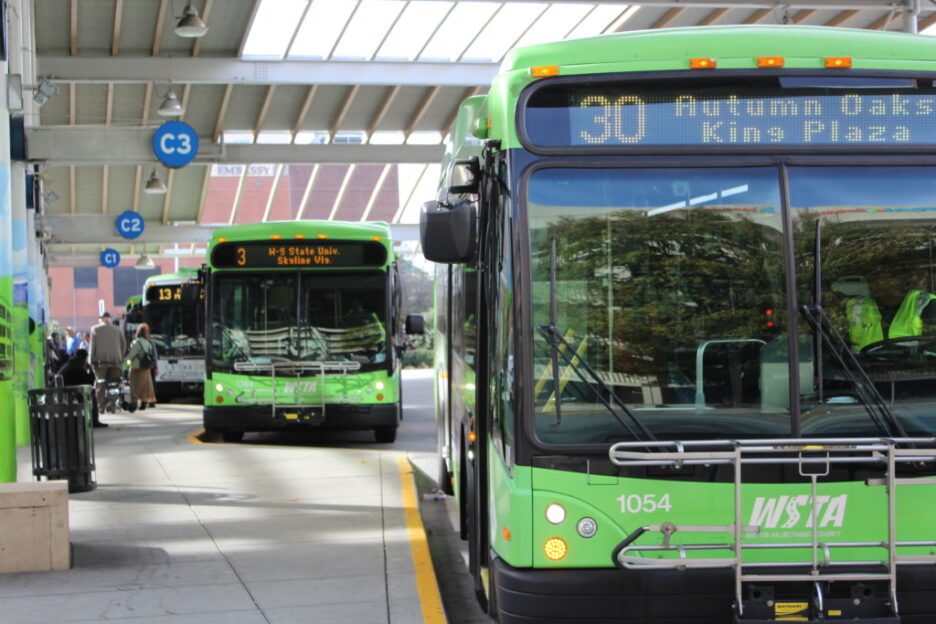
The Winston-Salem Transportation Authority received $920,000 last month from the Congestion Mitigation and Air Quality program in order to continue enhanced weeknight and weekend service in 2022.
Many of WSTA’s passengers depend on night and weekend service. Route 92 passenger Raquel James says that without it, she wouldn’t be able to get home from her job.
“I work the second shift at the hospital and without late service, I wouldn’t have a reliable way to get back home after work,” she said while waiting for the 9:30 p.m. weeknight bus after her shift at Novant Health Forsyth Medical Center.
The funds were allocated as a result of a March 18 meeting with the North Carolina Department of Transportation, where a total of $1,794,028 was allocated to WSTA to maintain service and replace buses and other capital items.
Night service on Route 92 has been one of the most pivotal improvements from the series of changes WSTA made to its network in 2018. The route serves Cleveland Avenue Homes, the Akron Drive area and a large swath of East Winston in between US-52 and Oak Summit Road. Weeknight service on this route served 123,167 passengers in 2019, the most of the eight routes that saw weeknight service added as a result of the 2018 changes.
Another route that saw weeknight service added in 2018 was route 104, which served 55,459 passengers with the enhanced service in 2019. Passenger Valery Escotto has benefited from this change, as the route helps her get home to Waughtown, a neighborhood southeast of downtown, after hanging out with friends after work.
“I like the night service on 104, because I always go home late after being with friends so it’s very convenient for me,” she said while waiting for her bus at the transit center.
Along with the continuation of weeknight service on routes 92 and 104, the federal funds will be used to continue weeknight service on routes 80, 86, 91, 94, 106 and 108 in 2022, along with Saturday service on routes 80, 86, 91, 92, 104, 106 and 108 and Sunday service on 80, 86, 90, 94, 101, 104, 106, 107 and 108. In total, maintaining these services in 2022 will cost a total of $1,148,009.60, with the federal grant covering $920,000. WSTA will pay for the remaining 228,009.60 with funds allocated by city council.
All of these services were added in 2018 as WSTA introduced sweeping changes in order to improve its operations. The changes included more crosstown routes, community circulator routes, which are routes that start and end outside of downtown, as well as the weeknight and weekend service on the aforementioned routes. The eight weeknight services served a total of 595,913 passengers in 2019, while the seven Saturday services had a combined 75,548 passengers. The nine Sunday services served 42,633 total passengers.
A Route 94 passenger who identified himself as “Wayne” said that he’s glad to know that these routes will maintain their enhanced service in 2022, but he wants WSTA to dream big in regards to service expansion in the future.
“I’m happy that they’re keeping the improved night and weekend schedule, but one thing I would like to see in the future is a full, 24-hour system. I don’t know if that’s possible in a city like Winston-Salem, but I would like to see that one day,” he said.
While there aren’t any plans to implement a 24/7 schedule in the near future, WSTA operator Anthony Mosley agrees that night service is a fundamental part of serving passengers, and he proposed a similar concept when asked what he would implement if he could make any improvement he wanted to WSTA.
“A lot of my passengers work very late at night, and they need a reliable way to get home. A full 24/7 schedule would give people a lot of flexibility with their work schedules, and would be top of my list if I could improve anything about our service” he said.
